Monday, June 7, 2010

Philippe Starck chairs available at Sample Board Online & TV show Design for Life


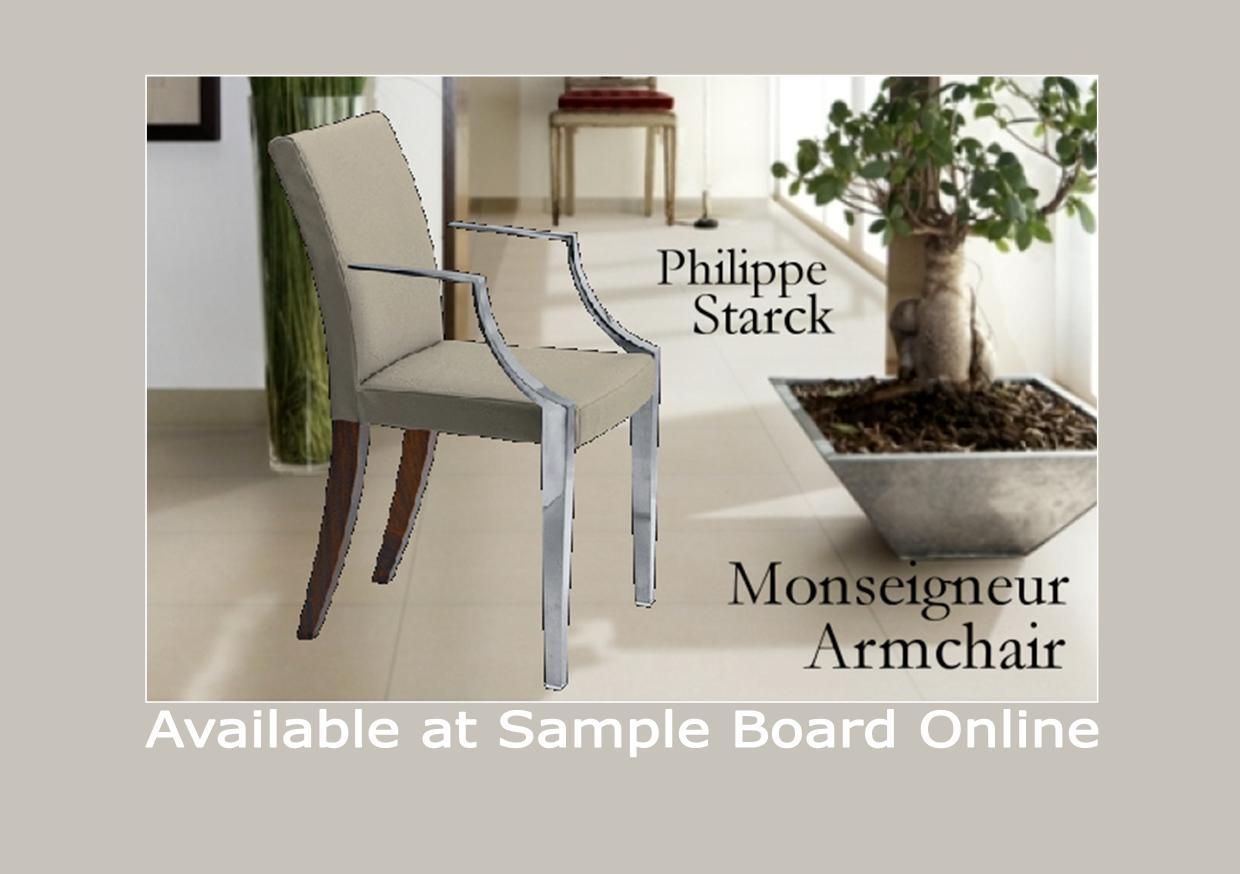
Sample Board Online (SBO) the cool eco friendly interior design tool always has the best designs from the suppliers of quality interior design products. The Spazio Company featured on SBO is the supplier of some brilliant Philippe Starck chairs.


I finally watched the TV show Design for Life. The program is a 6 part series like an X Factor/Biggest Loser hybrid. During the show twelve British designers/students vie to win six months at the Philippe Starck studio in Paris.


Most people know Starck the famous designer one of his most famous designs the Louis Ghost Chair. He reveals some of his views on design; there are too many useless and non sustainable products. He encourages would be designers to look at the story behind the product. Design he believes should help society toward a better life.  
I totally agree with him. For a number of years now I have been interested in public and community health and design. At some stage I would love to do some research on the topic. I had even thought of going a Masters using this topic as a research project. But at this stage time and money have put the idea on hold. 


In the first episode Starck sent the budding product designers to find items in a supermarket. The articles selected have to fall into one of three categories functional, ecological or gender. Each person was asked to find two objects within one of these categories. 
With the functional choice a product considered to be functional and one not very functional needs to be selected. In the ecological category an environmentally sustainable product should be found and a non sustainable product should also be found. In the gender category a male and female related product should be selected.

The two people who do not accomplish this task successfully will be sent home. One of the main things this exercise revealed to me was the tenancy we have to go into panic mode when we are out of our comfort zone. I must admit I have been guilty of doing just that in similar situations.
It has a lot to do with confidence and self talk. If we are confident and positive we are more likely to relax and let the creative juices flow. Philippe wanted the searchers to think outside the box. This is difficult to do when we feel panicked. 


The young man who seemed to most impress Starck and his team did not panic he was confident and was positive in his words. I did find him a bit cocky and over confident. It will be interesting to see how he goes with other tasks.
Another thing revealed during this exercise was the amount of time spent, writing, researching and procrastinating. Designers do need time to think. With experience the ability to think and make decisions quickly will come. But it takes time to learn this skill. It’s really about left and right brain thinking and the ability to tap into the creative side. Well that’s what I think.  


I will follow the next episodes with interest.
‘Get the habit of analysis - analysis 
will in time enable synthesis 
to become your habit of mind'
Frank Lloyd Wright         

Saturday, June 5, 2010

Art Deco lives on in The Cloud


Art Deco style often had classical design and motifs as a starting point. The designs were then simplified or abstracted to create new innovative designs. French designers led the way until the US embraced the new style and made it their own.

The straight lines and geometric forms of Art Deco were often married to the emerging modern International Style. The US Art Deco then went on to influence many other countries around the world.


The Cloud
A set of furniture called ‘The Cloud’ was a classic Art Deco design created in 1929 and became popular in France and England. The original pieces were small scale parlor sets; chairs, sofas and love seats. 


The Cloud design was re-introduced by the Richam Corporation in New York in 1984. The living room suites are still made in the US in a wide range of leathers, fabrics and exotic timbers.    
Designers and decorators found the furniture suitable for commercial use in hotels, waiting rooms as well as for domestic use. They often use the cloud chair for group seating in lobbies. I just love the design. 
Gouda Pottery
Gouda Pottery has a magnificent range of Art Deco pottery produced in Holland (Netherlands). The ceramics were designed at Schoonhoven Pottery and other regions in the 1920’s. Potters like Henri Bredvelt created pottery in vivid colours.


Dutch Gouda Pottery and Delftware in Yorkshire has a website dedicated to this wonderful range of pottery. The site has loads of information, images and links and is well worth a visit http://www.goudadesign.co.uk/
In Ireland when I was growing up dinner sets and other ceramics were often refered to as delf. When we arrived on holiday from England and an Aunty asked us to up the delf on the table we had no idea what she was talking about. I’m not sure if the term is still used today. When I finally get back to Ireland I must remember to check.


Link to Art Deco Quiz
Well this brings me to the end of a look into the Art Deco era. I have had a wonderful time rediscovering this brilliant style.  If you would like to test your knowledge just follow this link and try a fun Art Deco Quiz. http://www.vam.ac.uk/vastatic/microsites/1157_art_deco_quiz/quiz.php?ref=st08a

‘An idea is salvation by imagination’
Frank Lloyd Wright

Wednesday, June 2, 2010

Aussie, New Zealand & South African Art Deco


As I have spent time looking at the Art Deco period I have had moments of memories flooding my mind. I remember the visits to the Art Deco style Broadway cinema in Belfast when I was a small child.This building was so different from the other luxurious cinemas we usually went to.

Besides the Art Deco fireplace and cabinets my Granny also had the stuffed curved chairs and sofa of the era. (Many’s a time as the Irish say) I was told off for sitting on the arms of the furniture. My Gran was always telling us to act like ladies.

We were not allowed to chew gum, cross one leg over the other at the knees, whistle or speak until spoken to. The same lady my Gran who enforced these restrictions completely changed character on a Saturday night when the whole family would sit around the fire. Each family member told a joke, sang a song or told a ghost story. Granny’s stories and jokes were usually the best.

Next morning Sunday Gran was back to her old self. She would call everyone to get up and go to church. ‘We are not a pack of heathens’ she would say. I smile as I remember her many similar statements. My Gran from her over stuffed bulky chair beside the fire ruled the roost. 

I am so enjoying looking at the Art Deco era I don’t quite know how to end. There is so much still to tell. But I feel I do need to move on. The short Art deco era produced many wonderful buildings and items so I thought I would try and finish the topic by looking at some examples of Art Deco work around the world.        
      
In Australia
Innisfail in Queensland is thought to be the Art Deco capital of Australia. The Chelsea Park guesthouse in the Southern Highlands just south of Sydney is an example of Art Deco in NSW. Many Art Deco buildings exist in Victoria many cinemas and theatres; Art Deco in style. If you follow this link http://www.caths.org.au/ you can find examples of cinemas and theatres (in Victoria) many in Art Deco style.

New Zealand
There are many Art Deco buildings in Hastings, Wellington and Palmerston North


South Africa
Durban has many Art Deco buildings. Prince Edward Street has some fine examples. The South Africa Art Deco style was influenced by the USA Art Deco style. If you go to this link you will find more information and virtual tour http://users.iafrica.com/a/an/andryn/


 I will finish this blog now and complete the study of Art Deco in my next blog.

Saturday, May 29, 2010

German and Scandinavian design during Art Deco Era

The Art Deco era was considered a time of luxury, vitality, exuberance and decadence. At the same time  eclectic styles and a move to modernism was evident. Historical sources as a starting point for new designs were diverse. Industrial methods and technological advances were also being used.


The most famous influence on modern design the Bauhaus was opened in Germany by Walter Gropius in 1919. This school of design combined architecture, industrial and graphic art.


The principles of William Morris and the Art and Craft movement were embraced. Fine art and practical craftsmanship were combined and the needs and influence of the modern industrial world were a major consideration. The International Style grew from these beginnings. The new profession of industrial design also developed at this time. Industrial design and Art Deco design led to the streamlined designs of kitchens and bathrooms.


In the Scandinavian countries the ‘Swedish Modern’ and ‘Danish Modern’ styles appeared. Traditional craftsmanship and materials were honored and comfortable interiors and furniture the result. The work tended to be warm and avoided what some thought the cold appearance of modern designs.


Gunnar Asplund’s Senna Chair was designed in 1925 as was Bruno Matheson’s Extension Table. Both examples of Swedish design. Kaare Klint’s furniture and Mogens Koch’s folding furniture are examples of Danish design. The Finnish designer Eliel Saarinen’s interiors and furniture have strong Art Deco links.

Thursday, May 27, 2010

Images for Article Winning Placements


For those of you who have followed the link from the article 'Winning Placements: How 2 arrange your furniture like a professional interior decorator' I have placed some illustrations as promised in this blog


The most common mistakes made when arranging furniture
  • Placing all the furniture against the wall
  • Placing a large piece of furniture diagonally across a corner of the room
  • Placing large pieces of furniture in a small room
  • Placing too many pieces of furniture in a room


Wednesday, May 26, 2010

Art Deco UK


The fireplace with mottled tiles, brass fire implements and the beautiful curved sideboard I now recognise as Art Deco. As a child I was unaware of how valuable (what I thought old and dated) were the furniture and accessories of my granny’s Irish home. Although the wallpaper and linoleum were often changed the old fireplace and Art Deco furniture and other pieces remained. I disliked the fireplace. This could be due to the fact I often had to clean out the ash, set the fire ready to light and go out into the cold night to get coal. 

I now value the pieces of Art Deco and can appreciate the workmanship and design. My granny would have bought many of these pieces in the first years of her married life yet they were still there when we left Ireland for Australia in the 1970’s.   
  

In the British Art Deco home living rooms had the fireplace surrounded with pink, green or beige mottled matte tiles. Other colours used in the room were creams, eau-de-nil or oyster. The timber furniture tended to be pale and veneered in simple designs. Up lights, frames, mirrors and other items had stepped profiles.


The fabrics used in upholstery were plain or geometric. The linoleum floors had abstract designs or were black and white check. Parquet floors were also popular. In the 1920 UK magazine ‘Idea Home’ had an article on how to make large cushions in luxurious fabrics with tassels. Cushions in this style were the latest craze in the UK the article title; ‘The Indispensible Cushion: How to make them and where to place them’ 


Red and black tiles made by Carter & Co in Dorset England designed with graphic linear motifs based on objects like fans and stylized flowers were also popular. The tiles were mottle matte eggshell glazes with random crackles and star burst effects and used to tile around fireplaces were also used for entire kitchens or bathrooms.
The bold geometric patterns and designs in the Hoover Building is a brilliant example of Art Deco design in the UK. The Hoover factory in Perivale West London was built in 1932 and designed by Wallis Gilbert and Partners and is a well know example of the Art Deco style in Britain.   


One of the finest examples of Art Deco in the UK is Eltham Palace. If you go to this link http://www.english-heritage.org.uk/book-and-buy/venue-hire/eltham-palace/ you will find information and details on Eltham Palace built in the 1300’s. 

An Art Deco extension was commissioned in the 1930’s by the owners. The 15th century Great Hall was also restored. Art Deco the style went into decline about 1935. However there have been revivals in the 1960’s and 1970s.    


Tuesday, May 25, 2010

How you can save on the cost of printing

Some recent research has revealed a way of reducing the cost of printing. Apparently the type of font used for letters, quotes, reports and notices can reduce the cost of printing. It is estimated 31 % of an ink cartridge can be saved by using the right font.

Printer.com tested how to cut costs using two computers the Canon Pixa MP210 and the Brother HL-2140. They found money could be saved by changing the font. Between $20 and $80 per year could be saved.


Ten fonts were tested. Arial one of the most popular fonts was used as a zero measurement. And the winner is Century Gothic. 31% savings was found to be possible using Century Gothic on both printers.

For organizations who use numerous printers this could add up to hundreds of dollars saved per year. The Century Gothic font won over the Ecofont. This is amazing as the Ecofont was especially designed to reduce cost.

You can find details on this research  @ http://tinyurl.com/c2znc2